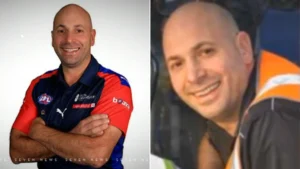




Chris Dawson’s name still resonates throughout Australia. His case has been associated with one of Australia’s most unsettling unsolved disappearances for over forty years. His wife, Lynette Dawson, went missing unexpectedly in January 1982, leaving her family seeking for answers and the public with unanswered questions.
What makes this case so significant for Australians is not the crime itself, but the incredible length of time it took the legal system to reach a settlement. Even now, it serves as a grim reminder that, while justice can be slow, it is not necessarily impossible to achieve.
Who is Chris Dawson?
Chris Dawson is a former New South Wales school teacher and ex-rugby league player. In the early 1980s, he was residing in Sydney with Lynette and their children. Lynette’s disappearance thrust Dawson into the spotlight, despite the absence of charges for many years.
For years, the case lingered, almost forgotten. But in Australian communities, particularly in New South Wales, it was a different story. The questions about Lynette’s vanishing act never really went away, echoing through the years.
The Disappearance of Lynette Dawson
Lynette Dawson was last seen in January 1982. Prosecutors would later claim she died sometime around the 8th or 9th of that year. Despite fresh investigations and a lot of public interest, her body was never recovered.
Her disappearance became a growing source of anger and distress. For those in Australia who followed the case, it was difficult to fathom how someone could simply vanish without a single clue. The absence of physical evidence presented significant obstacles to any potential prosecution.
Why the case remained unresolved for so long
For many years, no criminal charges were laid. The passage of time resulted in the ageing of witnesses, the deterioration of memories and the deaths of individuals associated with the case. These prolonged delays later hindered the investigation and made it far more difficult to present evidence effectively in court.
From a legal perspective, long delays can create what is known as forensic disadvantage. This term describes situations where a defendant might struggle to build a strong defence because important evidence or witnesses are unavailable. These issues then became central to the defense’s legal arguments.
Renewed attention and the road to trial
Years later, the case revived because to investigative journalism and the popularity of podcasts. The public’s excitement grew and pressure rose for a fresh look at the facts.
This renewed scrutiny eventually resulted in Chris Dawson facing murder charges. Given the case’s extensive media coverage, the trial was held as a judge-alone proceeding in the Supreme Court of New South Wales, rather than before a jury.
The murder conviction
In August 2022, Chris Dawson was convicted of the murder of Lynette Dawson. The court determined that Lynette had died in January 1982 and that Dawson was the one responsible, even though her body was never found.
For many Australians, the outcome was a landmark moment. Murder convictions without a body are uncommon and the ruling illustrated how courts can evaluate circumstantial evidence in its entirety, rather than relying on a single piece of proof.
Sentencing and imprisonment
In December 2022, Dawson received a 24-year prison sentence, with an 18-year non-parole period. The sentence reflected the seriousness of the crime and the profound breach of trust involved.
For Lynette’s family, it brought a sense of closure after decades of uncertainty. For the public at large, it demonstrated that even cases from long ago could still lead to justice.
Appeals and final outcomes
Dawson appealed his conviction. In June 2024, the New South Wales Court of Criminal Appeal unanimously rejected his appeal, upholding the initial ruling.
He subsequently sought special leave to appeal to the High Court of Australia. In June 2025, the High Court rejected the application. This ruling effectively ended the legal battle, cementing the conviction.
Why this case mattered so deeply to Australians
A rare conviction without a body
Australians were captivated by the case, which demonstrated that justice could still be served, even in the absence of physical evidence.
A powerful example of delayed justice
The case prompted significant debate about whether justice, even when delivered decades later, could truly bring solace to the families of the victims.
The media’s role in revealing the truth
Investigative journalism was instrumental in bringing the case back into the public eye, sparking conversations about the delicate balance between public interest and the rights of the accused.
Broader Legal and Social Impact
The case’s ramifications extended to national dialogues concerning historical offences, the pursuit of accountability and the implementation of “no body, no parole” statutes.
Other Legal Matters and Public Discussion
Additional legal proceedings involving Dawson, distinct from the murder trial, were extensively covered by the media and sparked public discourse in Australia regarding safeguarding protocols, power dynamics and institutional accountability.
It is crucial to recognise that these matters are legally independent of the murder case, encompassing different allegations and resulting in varied outcomes.
Conclusion
The Chris Dawson case endures as a preeminent true crime narrative within Australian history. It exemplifies the potential for legal resolution in long-standing mysteries, even following protracted periods of silence. Despite the conclusion of the court process, the case continues to influence national conversations concerning justice, accountability and the enduring effects of unresolved disappearances on Australian families.